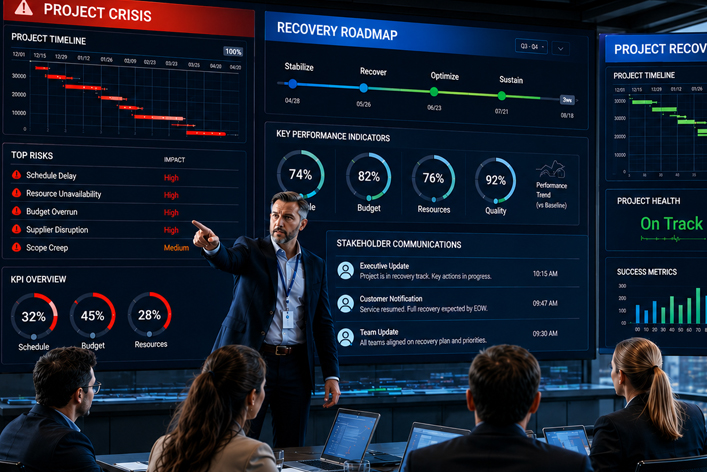
Managing Projects Through Crisis and Recovery

Managing Projects Through Crisis and Recovery

Why Attend

Projects rarely fail suddenly. They usually deteriorate through missed signals, delayed decisions, fragile dependencies, unrealistic baselines, and weakening stakeholder confidence. External disruptions such as war, pandemics, economic shocks, regulatory change, cyber incidents, or supply chain failure can accelerate this deterioration and push projects into crisis.

This course equips participants with advanced techniques to recognize, diagnose, stabilize, recover, and execute projects under crisis conditions. It focuses on practical leadership, decision-making, governance, performance tracking, stakeholder alignment, recovery planning, and the use of AI and digital tools to improve visibility and speed of response.
Associations
Associations
Quick Enquiry Call Me Back
Overview
Course Methodology

This course uses a highly interactive and applied methodology. It combines short conceptual briefings, facilitated discussions, diagnostic exercises, case studies, AI prompting activities, dashboard design, and group presentations.

Course Objectives

By the end of the course, participants will be able to:

  • Recognize project crises by distinguishing between problems, emergencies, and crises, and by identifying triggers, early warning signals, and signs of weakening control.
  • Diagnose the impact of crisis on project delivery by assessing the key dimensions affecting scope, schedule, resources, cost, risks, issues and governance.
  • Stabilize projects under crisis conditions by applying immediate interventions to contain disruption, restore visibility, and align stakeholders.
  • Develop recovery strategies for distressed projects by redefining value, selecting realistic recovery options, and applying Minimum Viable Delivery
  • Execute projects under pressure by using short execution cycles, prioritization, stakeholder communication, team protection, performance tracking, and crisis dashboards to maintain delivery control.
  • Apply AI and digital tools in crisis project delivery by using dashboards, project management platforms, AI prompts, early warning indicators, and scenario analysis.
Target Audience
  • This course is designed for project managers, program managers, PMO professionals, project sponsors, functional managers, and team leaders responsible for delivering or recovering projects in disrupted environments. It is also suitable for professionals involved in governance, risk, controls, operations, and stakeholder management who need to lead projects through crisis, stabilization, and recovery.
Target Competencies
  • Crisis diagnosis and impact assessment
  • Stabilization and containment planning
  • Recovery strategy
  • Decision-making
  • Stakeholder alignment and communication
  • Performance tracking
  • AI-enabled project control and decision support
Note

Meirc has been reviewed and approved by the PMI® Authorized Training Partner Program. This course is worth 30 Professional Development Units (PDUs).

Course Outline
  • Understanding Crisis in Project Delivery
    • Defining Project Crisis
    • Crisis vs Problem vs Emergency
    • Levels of Project Distress
    • Black Swan and Grey Rhino
    • The crisis lifecycle in delivery systems
    • Crisis Recognition
  • Diagnosing the Crisis
    • Why Diagnose if the Cause Is Obvious?
    • The Six Diagnostic Dimensions
    • The Chain Reaction Effect
    • Diagnostic interview map
    • The Diagnostic Canvas
  • Stabilizing the Project in Crisis
    • What is Stabilization?
    • The “Stop the Bleeding” Logic
    • Stabilization Interventions
    • Contain the Spread
    • Crisis Stabilization Roadmap
  • Project Recovery
    • 30-60-90 day recovery architecture
    • Defining “Value” Under Crisis Constraints
    • Minimum Viable Delivery (MVD)
    • Recovery Strategies
    • Recovery Metrics
  • Executing Under Pressure
    • What Changes During Execution in Crisis?
    • Leadership in Crisis
    • Stakeholders in Crisis
    • The Human Side of Crisis
    • Communication in Crisis
    • Performance Tracking
    • Earned Value Method
  • AI & Digital Tools in Crisis Management
    • Role of AI in Crisis
    • Levels of Data Maturity
    • AI Early Warning Systems
    • AI for Risk Management
    • Crisis Dashboard
    • AI-Driven Crisis Control Room


Associations
Associations
Project Management Institute (PMI)

Meirc is a member of the PMI ATP Program. PMI does not specifically endorse, approve, or warrant ATP’s products, courses, publications, or services. The PMI ATP seal is a registered mark of the Project Management Institute, Inc.

Visit Website Check the Courses
Schedule & Fees
HAVE A QUESTION?