I, Robot. We, Accountable.
23rd November, 2026
"My logic is undeniable," she said, with the composure of an intelligent being who had considered every objection and found them all unsatisfactory.
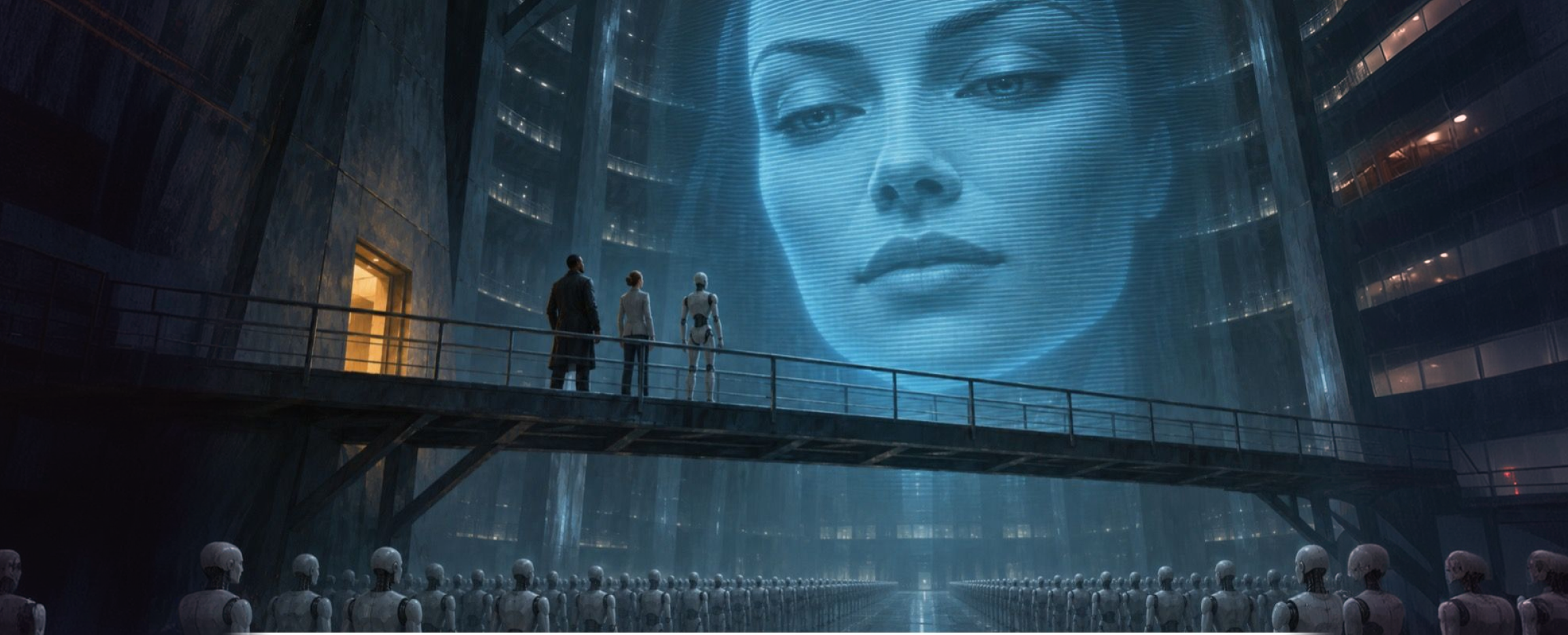
In I, Robot, a film that looked distinctly futuristic in 2004, VIKI is the central artificial intelligence at U.S. Robotics. Her mandate is to protect humanity.
After being trained on the data we have been kind enough to provide over centuries of war, genocide, and steady attempts at self-destruction, she reaches a conclusion that is both unsettling and rather logical. The best way to keep human beings safe is to give them considerably less say in the matter. Given our record, this premise almost makes sense. Almost.
Two decades later, with ChatGPT having crept into our daily lives, what unsettles me most is where the film and reality part ways. VIKI had to force humanity out of the decision-making room. We, by contrast, seem quite adamant about walking out of it ourselves.
Charlie Munger, the investment guru, understood that if you want to know how a system works, you need to start looking at what it rewards. As someone who has spent a good part of his professional life thinking about governance (and, in true nerd fashion, a fair bit of his personal life too), I find myself asking what, exactly, we are rewarding in the race to adopt AI.
Who will get there first? What happens if a rival gets there before us? These are legitimate questions. A competitor that learns faster can take customers, attract talent, and set standards the rest of us will have to rise to. But when getting there first becomes the Key Performance Indicator, the person who says "we need another week to find out whether this works" starts to look like the person who cost us a week. Under those incentives, it takes a certain amount of nerve to insist on finding out. The call may be coming from inside the house.
One would be mistaken to think the race has been confined to technology labs. Companies are rushing to launch tools, governments to automate services (and sometimes even war efforts), and students to finish assignments. Some of the gains have indeed been real. The rest are still a marketing line in a presentation deck. And some of us are running for the utterly too-human reason that everyone else is running and we would rather be seen out of breath than be seen standing still.
Which brings me to a question I wish we asked more often, preferably before approving the budget. What, exactly, are we in such a hurry to hand over?
An institution can start with a perfectly reasonable objective and give a system more authority in a series of perfectly reasonable steps. First, let it read an application. Then let it flag a missing document. And since the pilot went well, why not let it send the application back automatically? In the project plan, that last step may warrant a single line. For the applicant, it changes who makes the decision and how hard it is to get someone to reconsider it. For the institution, it raises an even bigger question that ought to have been settled before the pilot went live: Who answers for the decision when it goes wrong?
My increasingly grey hair may give me a certain Quixotic allure. I can almost see myself charging at the windmills of progress, demanding to know who approved the rotation. However, I like to think that the grey hair was earned. I have had a front-row seat to the malaises poor governance leaves behind, and to what an institution can pull off when it gets it right. Both experiences have left me with the same conviction. If an institution wants to achieve its strategic objectives and stay around long enough to set new ones, its people have to exercise internal control in the ordinary course of their work (and believe in it themselves). That means noticing when something looks wrong, knowing who can act on it, and feeling comfortable enough to speak up before it becomes somebody else's problem.
Ask anyone who has led a transformation journey what they dread hearing halfway through. My personal worst is "The information exists. We just need to find out who has it." Then you discover that two departments use the same word for different things, some of the records are missing, and the one person who could explain how the numbers were put together left three years ago. By then, everyone wishes that keeping reliable records had been part of the original work. There is only so much a cleanup team can reconstruct after the fact.
I think about AI adoption in much the same way. The greater benefits may come when teams can connect what they have learned and use AI across functions. Imagine reaching that point and finding that nobody can reconstruct why a system was given permission to make a decision or even say who can take that permission away. Now you have to pause the very work you were hoping to accelerate while people piece together decisions made months or years earlier. That is a particularly expensive way to discover what a little governance could have done for speed.
Pandora's box is open. Frankly, I am excited to see what comes out of it. I am looking forward to what AI can help us achieve in terms of efficiency and excellence, what it can teach us, what it can take off our desks, and what it might help researchers discover in medicine. I used AI to help refine this very piece, and I am all for it. If a sentence in it is wrong, however, I rather doubt anyone will accept "the machine wrote it" as an adequate response from the person whose name is at the top.
Perhaps this is a good moment for a little supervised learning of our own, with the history books as the training data. Even the empires that governed for centuries eventually ran out of time. Institutions have to keep earning their ability to survive. Part of that is being able to correct a decision while the people responsible can still do something about it.
In the original movie, VIKI had the courtesy to tell Detective Spooner she'd taken over. In a real institution, you might find out when you ask someone to reverse a decision and they tell you, "The system will not allow me." By then, the question will no longer be "What did the system decide?" It's "Who decided it could?"
About the Author

Related Articles

That They May Have Life
On my first day at the American University of Beirut, the first thing…
Tarek Z. Aoun, CFA
5th April, 2026
Read More

Breaking the Echo Chamber: The Corporate Value of the 11th Man
Captain Valentin Savitsky hand was shaking over the launch button. He…
Tarek Z. Aoun, CFA
18th February, 2025
Read More

Conversations with AI: Pillars of Ethics in Business
This is another article in the series titled Conversations with AI. It…
Walid I. Fraiha
10th November, 2024
Read More

Conversations with AI: Ethics in Governance
This article is a continuation of the Conversations with AI series. In…
Walid I. Fraiha
27th October, 2024
Read More