
Crisis Management in Action: What Organizations Must Do This Week
14th April, 2026
Across the region, organizations are no longer preparing for crisis.
They are managing it in real time.
The challenge now is not whether a plan exists, but whether it can be executed under pressure, at speed, and across multiple points of disruption.
Based on combined insights from Meirc’s crisis management and business continuity expert consultants, this guide outlines what organizations should be doing this week to maintain control, protect their people, and sustain operations.

Start with What Actually Matters
A common issue emerging right now is that organizations are focusing too heavily on systems rather than critical business services.
Facilitator of Meirc’s Business Continuity Management in Arabic course, Mohamed, highlights that many organizations still struggle to move beyond documentation to true operational readiness. Having recovery objectives or disaster recovery plans in place does not mean they can be executed under stress.
This week, leadership teams should:
- Identify their most critical services
- Confirm whether they can continue under disruption
- Define what minimum viable operations look like
Organizations should also be able to clearly answer:
- What will fail first?
- What must be recovered first?
If this cannot be answered quickly, it is a strong indicator that readiness is not where it needs to be.

Understand How Failure Will Cascade
One of the most significant risks in the current environment is interconnected disruption.
Facilitator of Meirc’s Certified Crisis Management Professional course, Robert, emphasises that organizations are still treating crises as regional rather than systemic, underestimating how infrastructure, supply chains, and digital systems are interconnected.
At the same time, Mohamed highlights that dependencies across third parties, SaaS providers, and cross-border teams are often not mapped end-to-end. This creates blind spots, particularly when vendors are impacted at the same time.
This week, organizations should:
- Map dependencies across operations, suppliers, and infrastructure
- Identify single points of failure
- Validate vendor resilience rather than assuming it
- Understand geographic exposure of key services
Without this visibility, disruption is likely to cascade and compound.

Move from Plans to Execution
A recurring theme across all experts is overconfidence in plans that have not been tested.
Robert highlights that untested plans can create a false sense of security, particularly when organizations assume disruption will be linear rather than simultaneous and multi-domain.
Similarly, Mohamed points out that too many organizations rely on theoretical exercises rather than testing their ability to operate under real conditions.
This week, organizations should:
- Run a short, high-pressure simulation at leadership level
- Include realistic scenarios such as:
- Vendor or regional failure
- Communication breakdown
- Loss of critical systems
- Test decision-making speed, authority, and coordination
The objective is not perfection, but to expose gaps before they are tested in reality.

Stabilise Communication Early
Communication breakdowns remain one of the fastest ways for a crisis to escalate.
Robert emphasises the importance of communicating early and regularly, even when information is incomplete, while clearly distinguishing between what is known, what is uncertain, and what actions are being taken.
At the same time, Mohamed highlights that communication failures often cause more disruption than technical failures, particularly when escalation processes and contact channels are not tested.
This week, organizations should:
- Test escalation processes and call trees in real conditions
- Ensure redundant communication channels are available
- Align leadership messaging
Clear, consistent communication is critical to maintaining stability and trust.

Enable Fast, Decentralised Decision-Making
In a crisis, delay is often more damaging than an imperfect decision.
Mohamed identifies decision paralysis and over-centralisation as key risks, particularly when organizations rely on approvals from a central authority.
Robert also highlights the importance of clarity in roles and authority to avoid overlap and confusion.
This week, organizations should:
- Clearly define decision-making authority
- Empower local response where appropriate
- Avoid bottlenecks that delay action
Speed and clarity are essential to maintaining control.
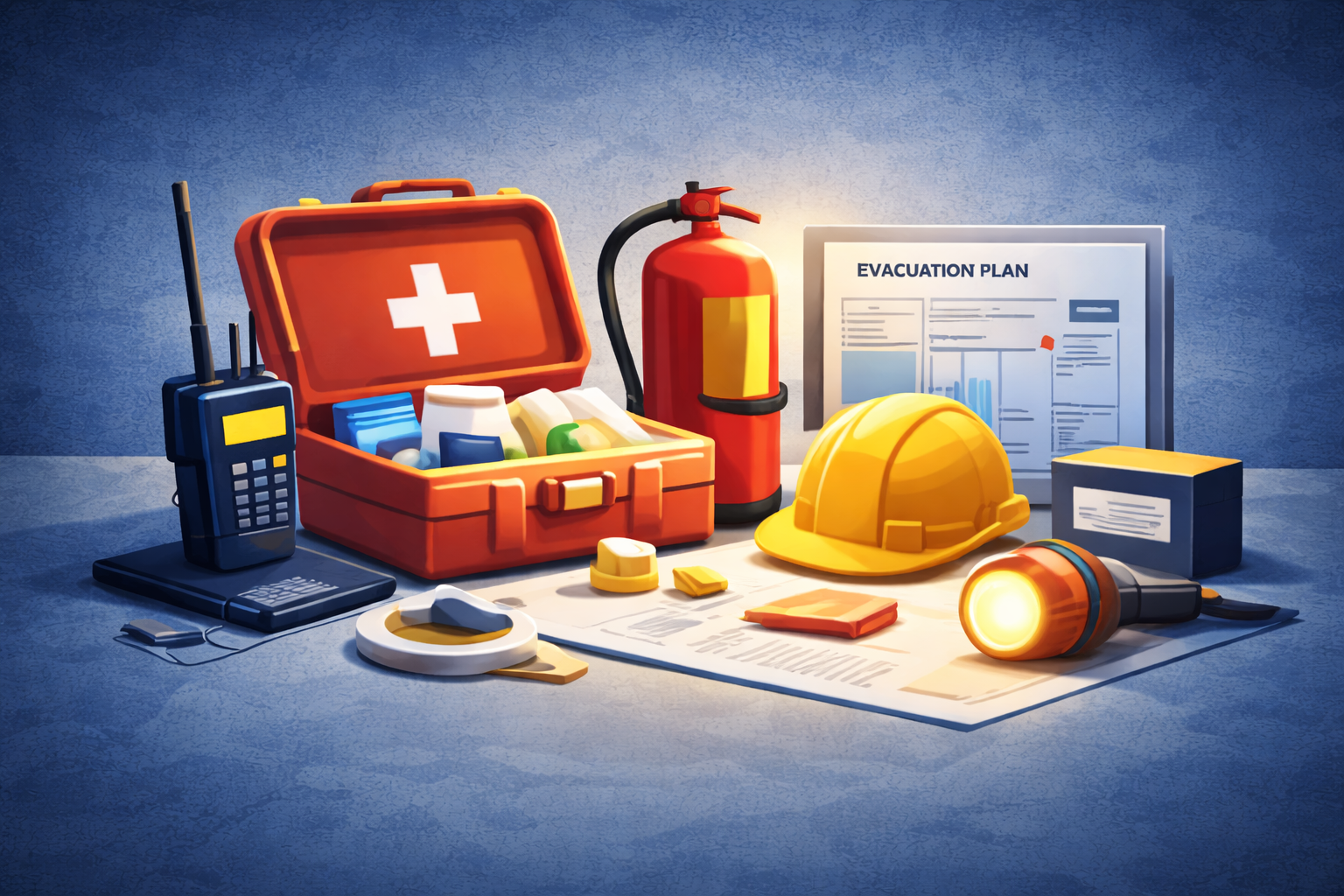
Reinforce the Fundamentals of Emergency Response
While much of the focus is on strategy, Facilitator of Meirc’s Business Continuity Management course, Andrew, highlights that organizations must not overlook basic emergency preparedness.
This includes:
- Reviewing evacuation, shelter-in-place, and safety procedures
- Ensuring communication methods remain available during infrastructure failure
- Verifying that critical documentation and equipment are accessible
AT also emphasises the importance of training and rehearsals. Without them, even well-designed plans can fail due to hesitation or uncertainty.
Practical readiness builds confidence, and confidence enables effective response.

Prioritise People, Not Just Operations
Crisis response is ultimately human.
Andrew highlights that individuals will naturally respond with fight, flight, or freeze, and that this must be acknowledged and managed. Emotional responses, uncertainty, and stress will directly impact workforce stability.
At the same time, Mohamed notes the risks of unclear duty of care decisions and misalignment between teams during disruption.
This week, organizations should:
- Confirm visibility of staff and contractors
- Ensure duty of care decisions are clear and consistent
- Provide practical, regular guidance
Leadership must provide clarity, reassurance, and direction, particularly in uncertain conditions.
A Simple Readiness Check
Based on combined expert input, organizations are more likely to be prepared if they can:
- Convene leadership and make decisions quickly
- Clearly identify and prioritise critical services
- Operate in a degraded mode if required
- Understand and validate dependencies
- Maintain communication across multiple channels
They are less likely to be prepared if they:
- Rely on untested plans
- Assume supplier resilience
- Have unclear decision-making structures
- Depend on a single system or communication channel
Final Thought
Crisis management is no longer theoretical.
It is being tested in real time.
As reflected across Meirc’s experts, organizations that will maintain control are those that can:
- Act early
- Simplify response
- Communicate clearly
- And execute under pressure
Preparedness is not defined by documentation.
It is defined by the ability to operate when disruption occurs.
About the Author

Related Articles

The Comedy of KPIs: Al-Meqyass Family Saga
Once upon a time, in a cozy suburban neighborhood, lived the Al-Meqyass…
Rabih Rizk
5th February, 2024
Read More

Public Sector Benchmarking: Driving Success Through Comparative Analysis and Innovation
When I worked in the public sector, benchmarking was one of the crucial…
Mohammed Nayal
9th April, 2023
Read More

Advanced Visualization Tools: Generating Sunburst Charts
Data visualization is a crucial aspect of data analysis, allowing users…
Mohammed Nayal
4th April, 2023
Read More

Cobras and the Law of Unintended Consequences
In my government strategy course, I present a public sector policy and…
Mohammed Nayal
1st August, 2022
Read More